- The Opening Print
- Posts
- Iran Tightens the Strait — But the Tape Won’t Break
Iran Tightens the Strait — But the Tape Won’t Break
Follow @MrTopStep on Twitter and please share if you find our work valuable!
Our View
In the big picture, the ES has been in a big back-and-fill pattern for the last two weeks. As It seems like Iran has the upper hand, and the more threats Trump puts out, the easier it is for Iran to reject.
They have bottlenecked the Strait of Hormuz and have flatly rejected the 45-day ceasefire and the 10-point plan, and currently hold the "tactical" upper hand regarding energy prices and regional disruption, but they are negotiating under the shadow of what the White House describes as "complete demolition" of their domestic infrastructure.
The world is watching!
Our Lean — Danny’s Trade (Premium only)

Guest Posts:
Rich Miller - HandelStats
Study:

Tom Incorvia - Blue Tree Strategies

XLK remains in a well-defined multi-month trading range, with sustained two-way auction between roughly 135 support and 149 resistance since November. The recent break below 135 failed to attract meaningful continuation, and last Thursday’s recovery back into the prior value zone signaled renewed acceptance within the established range.
Today’s session further supports that shift, as price held within the lower end of the broader balance area rather than being rejected back out. From a technical perspective, 135 is the key reference. As long as XLK continues to hold above that level, the bias favors range rotation toward the upper extreme near 149.

NVDA continues to mirror the broader technical structure seen in XLK, which is notable given its approximate 15% weighting in the sector ETF. Since August, price has largely been contained within a well-established acceptance range between roughly 174 and 195. Although shares briefly broke below the lower boundary, that move failed to gain traction and was quickly reversed, signaling a lack of sustained selling pressure below accepted value.
That swift recovery back into the range suggests the recent breakdown may have been an exhaustion move rather than the start of a new directional leg lower. From a market technician’s perspective, as long as NVDA remains above the 174 area, the setup continues to favor rotation back toward the opposite side of the range, with 195 serving as the key upside reference.

AAPL is showing a similar technical profile, with price spending the last several months auctioning within a clearly defined acceptance range between roughly 245 and 280. Recent weakness tested the lower end of that established value area, but sellers were unable to drive sustained trade below it.
The rebound back into the range suggests the market continues to recognize this zone as fair value rather than the start of a fresh downside trend. From a market technician’s standpoint, the lower boundary near 245 remains the key support reference. As long as AAPL continues to hold above that area, the bias favors further rotation through the range, with the upper extreme near 280 serving as the next major objective.
You can purchase Tom’s Course on Volume Profile here
Market Recap

The ES traded down to 6613.25 on Globex and traded up to 6651.25 before opening Monday's regular session at 6621.75, down 1.5 points.
After the open, the ES traded at 6621.50, rallied up to 6637.25, and pulled back to 6617.75 at 9:35. It made 4 higher lows and then rallied 43.25 points up to 6661.00 at 10:00. It sold off 37.00 points down to just below the VWAP at 6624.00 at 10:05, rallied 30.50 points up to 6654.50, and sold off 23.50 points down to the VWAP at 6631.00 at 10:45.
The index traded up to 6644.25 at 11:00, sold off 17.75 points down to 6626.50 at 11:35, and rallied up to 6644.00 at 12:00. It then traded 6635.75, rallied up to 6649.00 at 12:35, and sold off 30.25 points down to 6618.75 at 1:10. It rallied 25.25 points up to 6644.00 at 1:35, sold off 18.00 points down to 6626.00 at 2:00, and rallied 24.25 points to a 6650.25 double top at 2:25.
It pulled back to 6641.00 at 2:40, back-and-filled on a 4 to 6 point range until 3:45, and traded up to 6651.75. It traded 6651.00 as the 3:50 cash imbalance showed $1.6 billion to buy, and finally traded 6653.00 in the 4:00 cash close.
After 4:00, the ES reached 6654.25, traded down to 6646.50 at 4:15, and flat-lined into the 5:00 futures close. The ES settled at 6651.00, up 47.25 points or +0.72%, down 6.37% YTD. The NQ settled at 24,192.17, up 146.61 points or +0.61%, down 8.52% YTD. The YM settled at 46,946.00, up 168 points or +0.36%, down 7.83% YTD. The RTY settled at 2548.40, up 15.50 points or +0.61% on the day, down 7.94% YTD.
In the end, it was a quiet day of buying the pullbacks. In terms of the index's overall tone, they were firm. In terms of the ES’s overall trade, total volume was 1.64 million contracts traded, a decrease from the 1.8 million to 2.2 million contract average we have been seeing.
I'm not sure where the Middle East war is going, but so far, Iran is unwilling to negotiate an end to the war because it will not agree to Trump's 15-point agreement or a 45-day pause in exchange for opening the Strait of Hormuz. Trump reaffirmed his 8 p.m. ET Tuesday deadline for Iran to reopen the Strait of Hormuz, the critical oil shipping lane, warning that failure to comply would result in U.S. strikes on Iranian infrastructure and stating, “The entire country can be taken out in one night—and that night might be tomorrow night.”
He described Tehran’s counterproposal as “a significant step,” but said it was not good enough to secure a cease-fire. According to multiple U.S. officials, the U.S. military is actively preparing for potential strikes on Iranian energy targets.
The president also provided detailed remarks on the dramatic search-and-rescue operation to recover two U.S. airmen from Iranian territory, calling it “a rescue that’s very historic,” while U.S. officials offered few details on how Iranian forces were able to down an F-15E Strike Eagle and damage an A-10 Warthog attack aircraft on Friday.
Trump announced that the United States has launched an investigation into the leak of information about a missing airman to the media and floated the idea of the U.S. imposing a fee on commercial ships passing through the Strait of Hormuz. Iran also rejected Pakistan's two-phase plan but offered its own 10 -point plan. I keep thinking there will be a deal at some point, but right now it seems like Iran has the upper hand in the negotiations.
8:30 am Durable Goods
12:35 Chicago Fed President Austin Goollsbee speaks
3:00 Consumer Credit
5:50 Fed Vice Chair Philip Jefferson speaks
MiM
Market-on-Close Recap – MiM
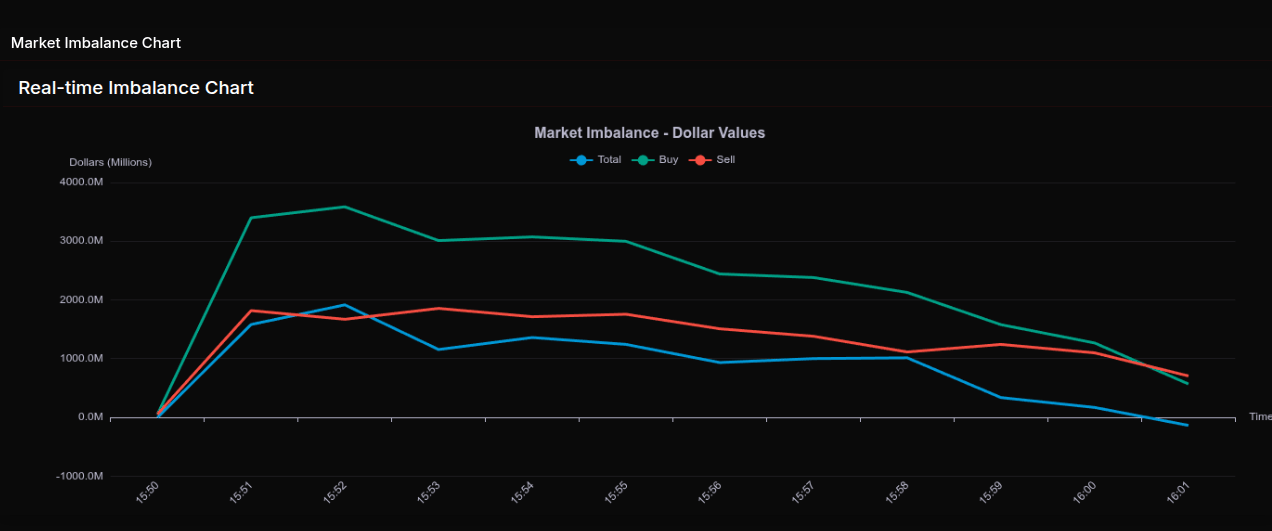
The MOC session opened with a sharp imbalance shift from an initial -$4M reading at 15:50 into an aggressive buy-driven tape by 15:51, where net imbalance surged to +$1.58B. Buy programs immediately dominated, printing over $3.3B versus $1.8B for sale, establishing a clear institutional bid early in the auction window. From 15:51 through roughly 15:55, the tape remained consistently buy-heavy, with $PCT readings holding in the 61–68% range—firmly directional rather than rotational.
As the session progressed, however, the imbalance began to decay. Buy notional steadily declined from peak levels (~$3.5B) down toward ~$2.1B into 15:58, while sell pressure stabilized rather than expanded. This created a compression phase, reflected in $PCT drifting toward the mid-50s by 15:59, signaling a transition from strong directional flow into a more rotational environment. By the close (16:01), the imbalance flipped negative (-$137M), indicating late sell-side dominance and a meaningful reversal in auction pressure.
Sector flows were broadly constructive early, with Technology (+79.1%), Financials (+82.3%), and Consumer Cyclical (+81.1%) showing strong buy-side conviction—well beyond the >66% threshold that indicates wholesale accumulation. Energy (+71.5%) also qualified as a strong buy sector. In contrast, Utilities (-74.6%) and Consumer Defensive (-71.1%) exhibited clear institutional selling, both exceeding the -66% threshold, suggesting defensive rotation out of safety.
Single-name flows reinforced this bifurcation. On the buy side, NVDA (+$331M), TSLA (+$150M), and V (+$143M) led, alongside semiconductor strength (MU, AMD, AVGO), confirming growth and beta demand. On the sell side, META (+$127M sell imbalance), IBM, and AAPL showed distribution, indicating selective profit-taking within large-cap tech despite broader sector strength.
Overall, the MOC evolved from a strong institutional buy program into a late-stage unwind. Early directional conviction gave way to rotation and eventual sell pressure, highlighting a market that began with aggressive risk-on flows but closed with signs of rebalancing and supply absorption.



Technical Edge
Fair Values for April 7, 2026:
SP: 38.93
NQ: 169.27
Dow: 211.35
Daily Market Recap 📊
For Monday, April 6, 2026
• NYSE Breadth: 60% Upside Volume
• Nasdaq Breadth: 67% Upside Volume
• Total Breadth: 66% Upside Volume
• NYSE Advance/Decline: 63% Advance
• Nasdaq Advance/Decline: 62% Advance
• Total Advance/Decline: 62% Advance
• NYSE New Highs/New Lows: 43 / 22
• Nasdaq New Highs/New Lows: 98 / 82
• NYSE TRIN: 1.09
• Nasdaq TRIN: 0.78
Weekly Breadth Data 📈
For Week Ending Thursday, April 2, 2026
• NYSE Breadth: 59% Upside Volume
• Nasdaq Breadth: 63% Upside Volume
• Total Breadth: 62% Upside Volume
• NYSE Advance/Decline: 75% Advance
• Nasdaq Advance/Decline: 73% Advance
• Total Advance/Decline: 74% Advance
• NYSE New Highs/New Lows: 151 / 305
• Nasdaq New Highs/New Lows: 191 / 734
• NYSE TRIN: 2.00
• Nasdaq TRIN: 1.53
ES & NQ Levels (Premium only)
Calendars
Economic Calendar

Trading Room Summaries
Polaris Trading Group Summary - Monday, April 6, 2026
Monday was a textbook Cycle Day 2, and the room did a solid job recognizing the environment early and adapting expectations accordingly.
Market Context & Open
Overnight gave a classic Sunday Globex dip (around 6575) that was quickly bought, recovering back toward 6650.
Key backdrop:
Europe closed (Easter Monday) → reduced participation
Expectation: smaller range, rotational behavior
David confirmed:
Cycle Day 2 → balance/consolidation
Ultimately played out as a clean, delta-shaped profile
Big theme: Conditions mattered more than forcing trades.
Trade Themes & Execution
Early focus on:
VWAP bounces
D-level interactions (reclaims > holds)
Awareness of tight range vs. 10-day ATR
Market behaved as expected:
Choppy, rotational
Respecting levels but lacking follow-through
AVWAP from Sunday low acted as support repeatedly
Standout Trade
Barbara’s A10 Trade
Executed a sell stop below market
Clean entry + exit at ATR Bull 10
Recognized by David as a “Nice A10 trade”
This was the ideal trade for the day’s conditions:
Mechanical
Level-based
No need to predict direction
Key Levels & Structure
“Big Pin” (options influence):
SPX: 6600–6605
ES equivalent: 6640–6645
Late-day:
$1.6B MOC Buy Imbalance
Reinforced the magnet / pinning effect in a balanced day
Education & Insights
Several strong lessons reinforced throughout the session:
1. Reclaims > Holds
David emphasized:
It’s not about holding levels — it’s about reclaiming them.
Important nuance for entries in rotational markets
2. Match Strategy to Environment
Traders identified:
“Ranging day → stay out” (Peter)
This is professional behavior:
Not every day is tradable for every system
3. Patience Over Activity
A great quote shared:
“Amateurs look for challenges. Professionals look for easy trades.”
This perfectly matched the day:
Best opportunities were quick, defined setups
Overtrading = getting chopped
4. Value of Deep Study
Strong endorsement of:
1-on-1 coaching
Backtesting (even using tools like AI)
Reinforces PTG principle:
Understanding the “why” beats memorizing setups
Psychology & Awareness
Traders showed growing maturity:
Recognizing low-quality conditions
Avoiding forcing trades
Focusing on specific setups only
Also notable:
Awareness of headline noise (Iran news, Trump speech)
Many acknowledged:
News = distraction unless it drives structure
Overall Takeaway
This was a discipline day, not a hero day.
The market gave:
Clean structure
Limited range
Rotational behavior
The best performers:
Took mechanical trades (like A10)
Or stayed patient and selective
Biggest lesson:
Knowing when NOT to trade is just as important as executing well.
Discovery Trading Group Room Preview – Tuesday, April 7, 2026
Macro Focus – Middle East:
Markets remain focused on the Middle East as Trump’s Iran deadline approaches. Messaging has been inconsistent—ranging from escalation to more conciliatory tones—leaving markets cautious but slightly optimistic on potential diplomacy.Energy / Oil:
Risk remains elevated around the Strait of Hormuz. JPMorgan warns gas prices could exceed $5/gallon if disruptions persist. Current prices are ~$4.12, up sharply over the past month.Equities / Semis:
Samsung posted a major profit surge driven by AI memory demand (HBM/DRAM). Supply remains tight, reinforcing bullish momentum in the AI chip space.Economic Calendar:
ADP Employment (8:15am ET)
Durable Goods (8:30am ET)
Consumer Credit (3:00pm ET)
Goolsbee speaks (12:35pm ET)
Earnings tomorrow: DAL, RPM
Volatility / Flow:
Volatility declined (5-day ADR ~119.75)
No strong whale bias (light, mixed flows)
Technical (ES):
Broke above short-term downtrend (~6619), now acting as support
Break above secondary trendline opens ~+200 pts upside
Failure back into channel opens downside toward ~6267
Key Levels:
Resistance: 6670, 6885
Support: 6619, 6267
Bottom line: Market is at a key inflection point—technicals are stabilizing, but direction will be driven by geopolitics and energy risk.

