- The Opening Print
- Posts
- Hormuz on the Brink, Crude on a Tear — Sell the Rips, Respect the Risk
Hormuz on the Brink, Crude on a Tear — Sell the Rips, Respect the Risk
Follow @MrTopStep on Twitter and please share if you find our work valuable!
Our View
By the time the markets opened last night, the world would get a better handle on the price of spot gold and oil prices, but this was where gold was trading yesterday:

India's spot gold prices have surged significantly following the recent escalation involving U.S. and Israeli strikes on Iran (including the reported killing of Iran's Supreme Leader Ayatollah Ali Khamenei), which triggered strong safe-haven demand for gold amid heightened geopolitical tensions in the Middle East.
As of March 1, domestic gold prices in India reflect sharp gains driven by international spot gold rising above $5,200–$5,300 per ounce (with some reports noting peaks near $5,299/oz or higher in recent trading).
Key Current Prices (as reported on March 1, 2026):
24-karat gold (per 10 grams): Around ₹1,62,000 to ₹1,73,000, with variations by city and source. Examples include ~₹1,73,080 (with +₹4,370 daily gain in some updates), ~₹1,62,180 in Mumbai, ~₹1,64,000+ in earlier surges, and reports of spikes up to ₹1,75,000 in Delhi amid the conflict.
22-karat gold (per 10 grams): Typically ~₹1,48,000 to ₹1,58,000 (e.g., ₹1,58,650 with gains).
Per gram examples: 24K at ~₹17,308 in some listings, reflecting the rally.
These are spot/physical market rates, closely tracking MCX futures (e.g., April gold futures around ₹1,62,000–₹1,62,100 per 10 grams, up ~1.5% recently).
The surge stems from investors flocking to gold as a safe-haven asset after the attacks, with analysts noting potential for further upside (some forecasting targets like ₹2 lakh per 10 grams if tensions worsen, alongside international gold possibly hitting $5,500+). Silver has also rallied sharply (e.g., near ₹2,95,000–₹3,00,000 per kg in spots).
Prices can vary slightly by city (e.g., higher in Delhi due to local premiums) and are influenced by global factors like USD/INR (~₹91), import duties, and market sentiment. Indian markets (including MCX) were closed over the weekend but are expected to open higher on Monday amid the ongoing risk-off mood.
For the most precise real-time quotes, check official sources like MCX, local jewelers, or platforms like Goodreturns/Moneycontrol, as rates fluctuate rapidly in this volatile environment.

Spot oil prices have surged sharply following the U.S. and Israeli strikes on Iran (including reports of the killing of Supreme Leader Ayatollah Ali Khamenei), escalating geopolitical tensions in the Middle East and raising fears of supply disruptions, particularly through the Strait of Hormuz.
As of March 1 (around midday EST, with markets reacting in real time; futures trading opened Sunday evening), crude benchmarks reflect strong risk premiums amid the ongoing conflict.
Key Current Prices (latest available closes and indicative moves):
Brent Crude (international benchmark):
Friday close (pre-escalation peak): Around $72.80–$72.87 per barrel (up ~2.9% or +$2.03 from prior, hitting 7–8 month highs near $73).
Over-the-counter/early indications post-attacks: Jumping ~10% to around $80 per barrel in some reports, with analysts expecting further upside when full trading resumes.
Spot/near-term futures: Trading in the $72.49–$73.21 range in recent updates, but poised for $5–$20+ gains if no de-escalation (e.g., targets up to $95–$110 in prolonged disruption scenarios).
WTI Crude (U.S. benchmark):
Friday close: Around $67.02–$67.29 per barrel (up ~2.8–3.19% or +$1.81–$2.08).
Indications: Similar risk-driven surge expected, potentially adding $10–$20 if Strait issues persist.
The rally stems from safe-haven flows and supply fears. Iran (a major OPEC producer) faces disruptions, and threats to close or block the Strait of Hormuz (transit for 20% of global oil) have led tankers to divert or anchor, with some attacks reported. OPEC+ responded by agreeing to modestly increase output (206,000 bpd in April) from members like Saudi Arabia and the UAE to offset potential losses, but this may not fully counter short-term shocks.
Analyst Forecasts and Scenarios:
Limited or no major disruption: Prices could stabilize or add $5–$10 on fear alone.
Prolonged Hormuz issues: Brent could spike to $80–$100+ per barrel (Barclays, RBC, and others cite $100+ risks; some warn of 1970s-style shocks).
Broader war: Even higher, with global economic impacts (higher gas prices, inflation pressures).
U.S. gasoline prices (already ~$3 per gallon average) could rise to $3.10–$3.25+ soon, with bigger jumps in vulnerable areas if crude sustains gains.
Prices are highly volatile and can shift rapidly — check live sources like CME Group, TradingEconomics, OilPrice.com, Reuters, or Yahoo Finance for real-time ticks (Asian and European markets open first, U.S. follows). The situation remains fluid, with potential for quick reversals if de-escalation occurs, but current sentiment is strongly bullish on oil due to the risk-off environment.
My guess is both continue higher, but like I said last week, this is a very fluid situation and could easily spin out of control.
Our View
Obviously, the U.S./Israel-Iran war is front and center now. Trump says it’s going to take a few weeks, but I doubt Iran will stop, and there is a big chance that the war leads to a wider response. Depending on what you read or hear on the news, Iran says it was getting closer to a deal, but I don’t think they were ever going to give up their enrichment or ballistic missile programs.
I am also convinced that by now, Russia or North Korea have already given Iran the technology to produce nuclear weapons. My concern is that I do not think Iran is going to back down, and even if there is a regime change, what will it look like, and who will be in charge?
One of the things I have always thought was crazy is that Iran is the world's largest Shia-majority nation, with Shia Muslims making up roughly 90% to 95% of the population. With a population of 93.2 million, the Shia make up 84 to 88.5 million people, and the Sunni population is 4.6 million to 9.3 million on the high end, and the IRGC is almost entirely Shia.
Regional Religious Demographics (2026 Estimates)

Globally, Sunnis make up about 85–90% of all Muslims. The concentration of Shia Muslims in the Middle East—particularly in Iran and Iraq—is what gives those two countries such significant influence in regional religious politics.
Our Lean
Market Recap

It’s been one thing after another, and if it’s not war with Iran spooking the markets or NVDA dropping over 10%, it was the Producer Price Index. The producer-price index increased by 0.5% last month, after rising by 0.4% in December, dampening speculation that the Fed would cut interest rates in the near term. Economists expected a 0.3% increase. Over the last 12 months through January, wholesale prices were up 2.9%, adding to credit fears.
The ES, which closed on a down tick Thursday, resumed its downward price action after a headline that Iran was not going to give up nuclear ambitions, pushing the ES all the way down to 6851.00, and it traded 6855.64 on Friday’s regular session open.
After the open, the ES traded 6853.25, rallied to 6867.75, sold off down to 6841.50 at 9:40, and rallied up to 6880.00 at 10:10. It then sold off down to a higher low at 6860.75, rallied up to 6885.75 at 10:24, pulled back to 6867.25, and rallied up to a new high at 6888.25 at 11:35.
The ES pulled back to a higher low at 6870.25 at 11:45, rallied back to the high at 6888.25 at 12:05, and sold off down to 6858.00 at 12:20. It rallied up to 6876.75 at 12:35, pulled back to 6859.75 at 12:45, and rallied up to 6872.25. The ES then sold off down to 6855.75 at 1:25, rallied back up to 6875.25 at 2:05, sold off to 6855.00, and rallied up to 6886.50 at 3:20.
It traded back down to 6870.75 at 3:35 and traded 6880.00 as the 3:50 cash imbalance showed $4.7 billion to buy. The ES traded up to a new high at 6894.00 at 3:55 and traded 6888.25 on the 4:00 cash close.
After 4:00, the ES sold off down to 6873.00 and settled at 6889.00, down 31 points or -0.45%. The NQ settled at 25.004.75, down 76.25 points or -0.30%. The YM settled at 49.000, down 531 points or -1.07%, and the RTY settled at 2634.70, down 45.90 points or -1.71% on the day.
In the end, the ES and NQ were range-bound in very choppy trade and rallied late (like they usually do after being down and on an expiration Friday) as a $4.3 billion buy imbalance showed up on the 3:50 imbalance. In terms of the ES’s overall tone, it was fairly standard for what we have been seeing — range-bound. In terms of the ES’s overall trade, volume was 1.576 million contracts, in line with Thursday’s volume.
Geopolitical risks remain a negative for stocks. Crude oil (CLJ26) rallied more than +2% to a 7-month high on Friday after President Trump sounded downbeat about diplomatic talks with Iran, saying, “They cannot have nuclear weapons, and we're not thrilled with the way they're negotiating.” Axios reported that U.S. negotiators, Kushner and Witkoff, left Geneva disappointed by what they heard from Iranian officials in the U.S.-Iranian nuclear talks. Iran's state media reported that Iran won’t allow enriched uranium to leave the country.
I am not surprised in any way that the U.S. and Israel attacked Iran.
Economic Calendar
MONDAY, MARCH 2
9:45 am – S&P Final U.S. Manufacturing PMI
10:00 am – ISM Manufacturing
TBA – Auto Sales
TUESDAY, MARCH 3
9:55 am – NY Fed President John Williams remarks
10:10 am – KC Fed President Jeff Schmid speaks
11:45 am – Minneapolis Fed President Neel Kashkari interview
WEDNESDAY, MARCH 4
8:15 am – ADP Employment
9:45 am – S&P Final U.S. Services PMI
10:00 am – ISM Services
2:00 pm – Fed Beige Book
THURSDAY, MARCH 5
8:30 am – Initial Jobless Claims
8:30 am – U.S. Productivity
8:30 am – Import Price Index
8:30 am – Import Price Index ex-Fuel
1:15 pm – Fed Vice Chair for Supervision Michelle Bowman speaks
7:00 pm – Chicago Fed President Austan Goolsbee speaks
FRIDAY, MARCH 6
8:30 am – U.S. Employment Report
8:30 am – Unemployment Rate
8:30 am – Hourly Wages
8:30 am – Hourly Wages YoY
10:15 am – San Francisco Fed President Mary Daly speaks
1:30 pm – Cleveland Fed President Beth Hammack speak

Guest Posts
MiM
The February 27th MOC session opened with an immediate expansion in buy pressure. At 15:50, the book was essentially flat at $38M, but by 15:51, total imbalance exploded to $4.686B, driven by $11.843B in buy orders versus $7.157B for sale. The early lean registered +62.3%, firmly directional but still rotational rather than wholesale. The imbalance peaked in momentum around 15:55, with buy programs touching $12.667B while sells held near $8.006B, keeping the percentage structure consistently in the low 60s. Into the 15:58–16:00 window, both sides compressed sharply, closing with a modest $55M net and a more neutral 50.9% split, reflecting late offsetting flows.
Sector rotation was aggressive. Communication Services led with a +93.0% buy lean, Consumer Cyclical printed +88.2%, Energy +85.8%, and Consumer Defensive +81.2%. These readings signal strong institutional accumulation, though not quite the >66% wholesale threshold in dollar-weighted terms across every name. Financials (+70.5%), Industrials (+72.2%), and Healthcare (+66.2%) reinforced the broad risk-on tone. Technology was the notable outlier at -63.5%, showing heavy supply, while Real Estate stood out with a -84.9% lean and -66.7% by symbol count — a clear wholesale sell imbalance and the most extreme sector reading of the session.
On the tape, large buy imbalances were concentrated in AMZN ($523M), LLY ($417M), JPM ($388M), COHR ($363M), and BRK.B ($302M). GOOG, TSLA, COST, META, and ABBV also showed meaningful demand. On the sell side, Technology heavyweights dominated: NVDA ($869M), MSFT ($870M), and AAPL ($476M) all carried sizable paired-off pressure. Real Estate names such as ELS and BXP added to sector weakness.
Overall, the close reflected broad index support (S&P +63.4% lean) with selective tech distribution and pronounced liquidation in Real Estate — a structurally bullish but rotational MOC.


Technical Edge
Fair Values for March 2, 2026
SP: 8.39
NQ: 35.96
Dow: 45.91
Daily Breadth Data 📊
For Friday, February 27, 2026
• NYSE Breadth: 45% Upside Volume
• Nasdaq Breadth: 40% Upside Volume
• Total Breadth: 42% Upside Volume
• NYSE Advance/Decline: 40% Advance
• Nasdaq Advance/Decline: 34% Advance
• Total Advance/Decline: 36% Advance
• NYSE New Highs/New Lows: 201 / 66
• Nasdaq New Highs/New Lows: 217 / 157
• NYSE TRIN: 0.84
• Nasdaq TRIN: 0.77
Weekly Breadth Data 📈
For Week Ending February 27, 2026
• NYSE Breadth: 52% Upside Volume
• Nasdaq Breadth: 55% Upside Volume
• Total Breadth: 54% Upside Volume
• NYSE Advance/Decline: 43% Advance
• Nasdaq Advance/Decline: 46% Advance
• Total Advance/Decline: 45% Advance
• NYSE New Highs/New Lows: 446 / 178
• Nasdaq New Highs/New Lows: 576 / 554
• NYSE TRIN: 0.70
• Nasdaq TRIN: 0.68
BTS Levels - (Premium Only)
Calendars
Today’s Economic Calendar

This Week’s Important Economic Events

Upcoming Earnings - SP500
Recent Earnings

Room Summaries:
Polaris Trading Group Summary - Friday, February 27, 2026
Market Context & Plan
David identified today as Cycle Day 3 – Capital Preservation Day, which immediately framed expectations:
Protect gains from earlier in the cycle
Be selective
Avoid overextending
Overnight upside targets had already been fulfilled, shifting focus to whether the market would:
Hold above 6895 ±5 (Bull Case) for continuation toward 6905–6915
Or lose 6895 ±5 (Bear Case) and rotate toward 6880 → 6870 → 6860
Key references were clearly defined:
PVA High Edge: 6924
PVA Low Edge: 6882
Prior POC: 6919
As always, David emphasized: These are magnets and battlegrounds — manage risk there, don’t chase emotion.
Early Fulfillments & Structure
Very quickly, the lower targets were fulfilled, including the Cycle Day 3 Violation Level (6851.31). That early fulfillment reinforced the importance of:
Letting price come to the levels
Executing the plan, not reacting emotionally
Understanding when inventory is being reset
Once those objectives were hit, David made it clear: the major objectives were done — anything else was bonus, not necessity.
High-Quality Trades
CL Open Range Short — All Targets Fulfilled
A textbook execution. Clean setup, clean targets, full completion.
This was a strong example of:
Structured open-range discipline
No chasing
Defined risk, defined reward
Letting the trade complete its job
Members acknowledged it as a “nice trade.”
D-Level Long Opportunity & First Pullback Play
David identified a D-Level long opportunity, followed by what appeared to be a clean 1st pullback play.
This reinforced:
Waiting for structure
Using levels, not opinions
Trading momentum within context
There was also discussion of a potential level reclaim trade, showing members are thinking in terms of framework, not randomness.
Cycle Day 3 isn’t about hero trades. It’s about:
Consistency
Repetition
Capital preservation
Taking what the market offers
Key Takeaways
When key targets are fulfilled early, shift from aggressive to defensive mindset.
CD3 = Protect capital. Don’t force continuation.
Open Range trades remain a high-probability play when executed within structure.
Build your personal playbook — screenshots and review accelerate growth.
Alignment with the day type is survival.
A strong, professional Friday session.
Capital preserved. Targets hit. Lessons reinforced.
DTG Room Preview – Monday, March 2, 2026
Macro / Geopolitics
Primary focus: escalating U.S./Iran conflict.
U.S. and Israel launched strikes after Iran rejected nuclear program demands.
Iranian leaders have promised a strong response, raising risk of broader Middle East escalation.
Reports indicate Iran’s Supreme Leader was killed in a targeted strike.
President Trump:
Said bombing campaign could last 4–5 weeks.
Warned Iran to “lay down your arms” or face further military action.
Confirmed three U.S. service members have died so far.
Key questions:
What are the administration’s exact objectives?
What is the long-term plan?
Risk of prolonged regional entanglement remains elevated.
Market Reaction
U.S. stock futures down ~1% into the European session.
Oil +13% (Iran is OPEC’s 4th largest producer).
Gold sharply higher on flight-to-safety flows.
S&P 500:
Closed lower Friday.
Finished February down.
Overall tone: risk-off, headline-driven.
Corporate News
Amazon Web Services (AWS):
Service disruption at UAE data center.
Fire reported after unidentified objects struck facility.
Power shut off by fire department.
Unclear if incident is tied to regional conflict.
Amazon operates 123 data centers globally.
Earnings
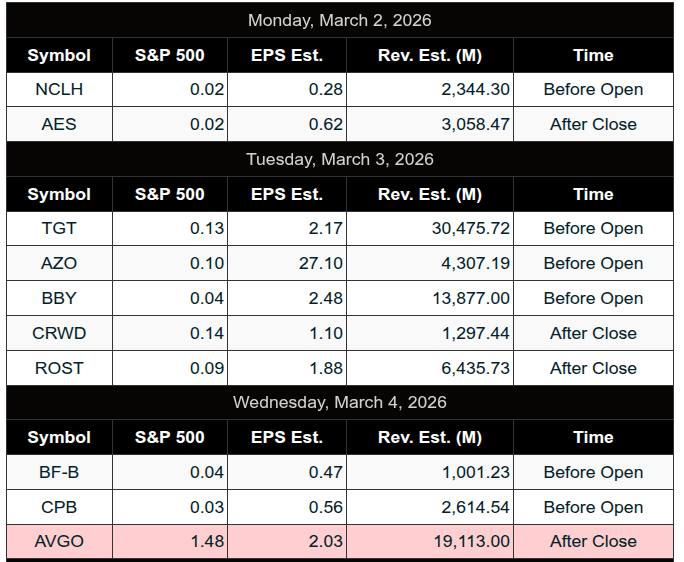
Premarket: NCLH, KSPI, SATS
After Close: AES
Tuesday Morning: AZO, BBY, SEA, SHG, SNN, TGT, VIK
Economic Calendar (Today)
9:45am ET – S&P Global Manufacturing PMI
10:00am ET – ISM Manufacturing PMI
10:00am ET – ISM Prices
Volatility / Positioning
Volatility remains moderately elevated.
ES 5-day average range: 90.5 points (flat vs. Friday).
No clear “whale” bias overnight.
Large trader flow mixed.
Some buying into the selloff.
Technical Outlook – ES Futures
ES remains in a 4-month sideways consolidation under all-time highs.
Closed below 50-day MA (6931) for 2nd straight session:
Short-term bearish signal.
50-day MA now loose resistance.
Broke intermediate-term uptrend channel bottom.
Opens downside toward short-term downtrend channel bottom.
Key Levels
Resistance (TL Rs):
6826/29s (former channel support)
6975/70s
7175/80s
Support (TL Ss):
6652/47s
Markets remain highly sensitive to geopolitical headlines, with technical damage increasing short-term downside risk.

